Objects
Every real thing — a property, reservation, person, folio, charge — is a typed object with a declared schema. Defined once, not reinvented inside every application.
- Property
- Reservation
- Folio
- Charge
Aerandil sits above your PMS, POS, RMS, and CRM. It turns their data into one typed, governed model — objects, links, actions, and events — that staff, software, and AI all operate through.
Every PMS, POS, and spreadsheet invents its own guest, reservation, and folio. Integrations move data between them, but they never agree on what it means. Aerandil makes the meaning the product: one declared model the whole operation shares, governs, and extends.
Every operation Aerandil runs reduces to four primitives — each one governing the next, from the nouns of the business to the append-only record of what changed.
Every real thing — a property, reservation, person, folio, charge — is a typed object with a declared schema. Defined once, not reinvented inside every application.
Objects connect through declared link types. A reservation belongs to a person; a folio holds charges; a stay occupies a room. The graph is the model — not a join you have to remember.
State only moves through actions: permissioned, validated, idempotent. The same governed contract for staff, software, and agents — no privileged back doors into the database.
Every committed action emits an append-only event. The operation's history is a fact you can query and replay — never edited after it happened.
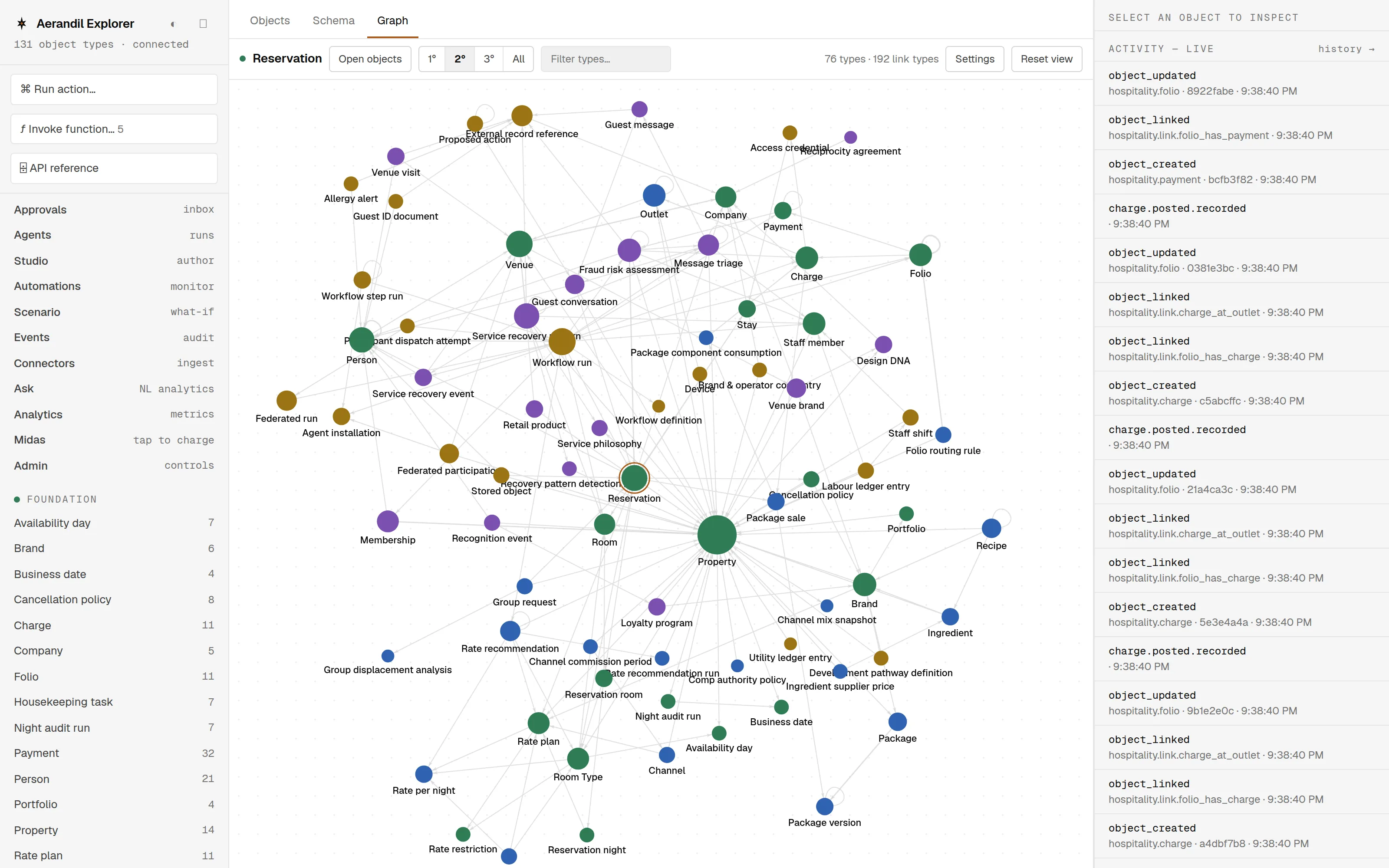
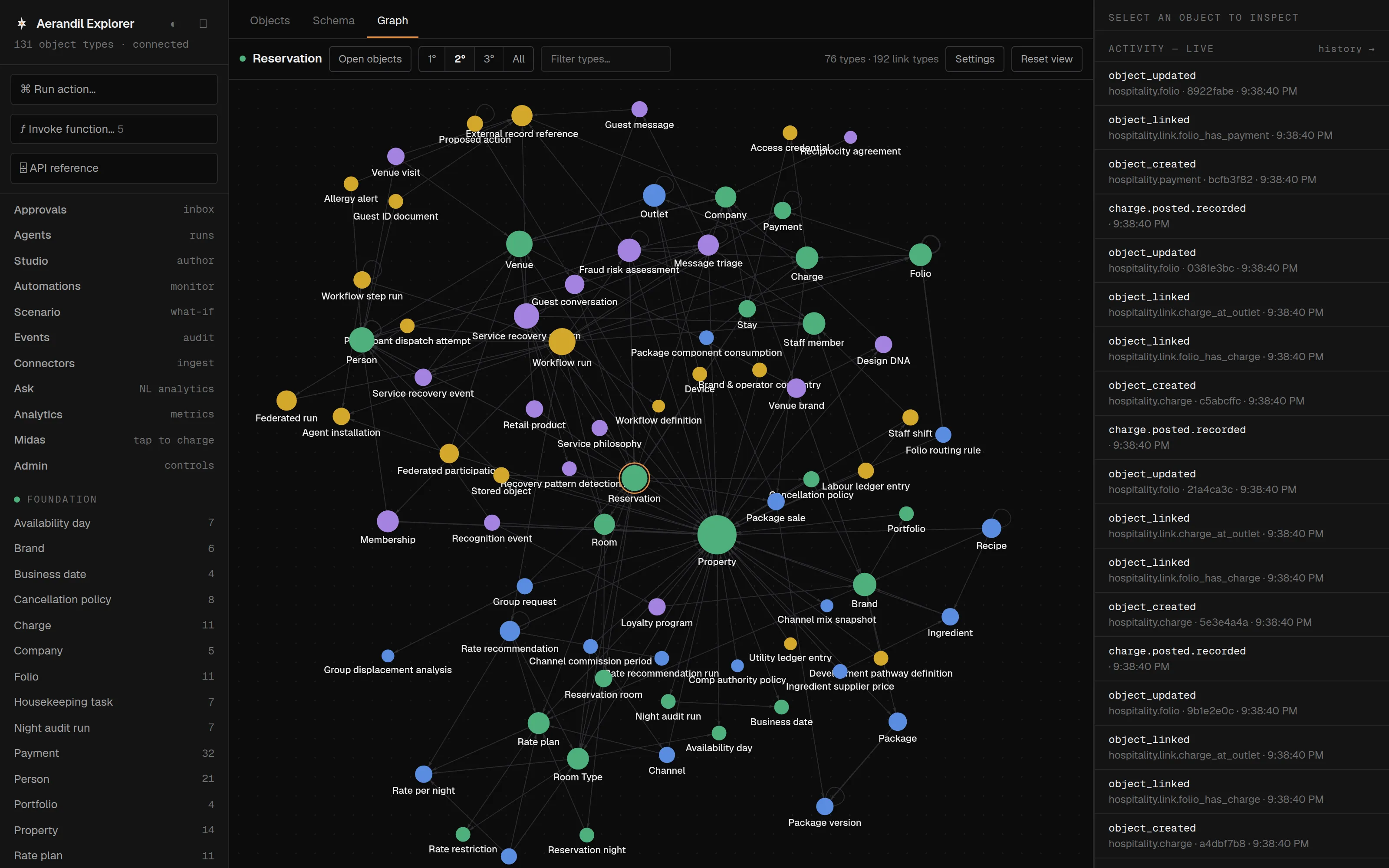
Two hops out from one reservation sit the guest, the room, the folio, the rate plan — and the workflows, fraud checks, and forecasts that govern them. Explorer renders it from the same registry the API serves, so the picture can't drift from the contract.
Aerandil ships an ingestion fabric: connectors extract from the systems a property already runs, land every vendor record verbatim, and fold it into the ontology through the same governed actions as everything else. No side doors into the database — not even for us.
Ecosystem extractors pull from the vendor's API — Opera, Lightspeed, Deputy, and the long tail.
Records land verbatim in a staging schema. The original is never thrown away.
A versioned, reviewable mapping declares how vendor rows become ontology operations.
Every record folds in through the same validated, idempotent, audited actions as any operator.
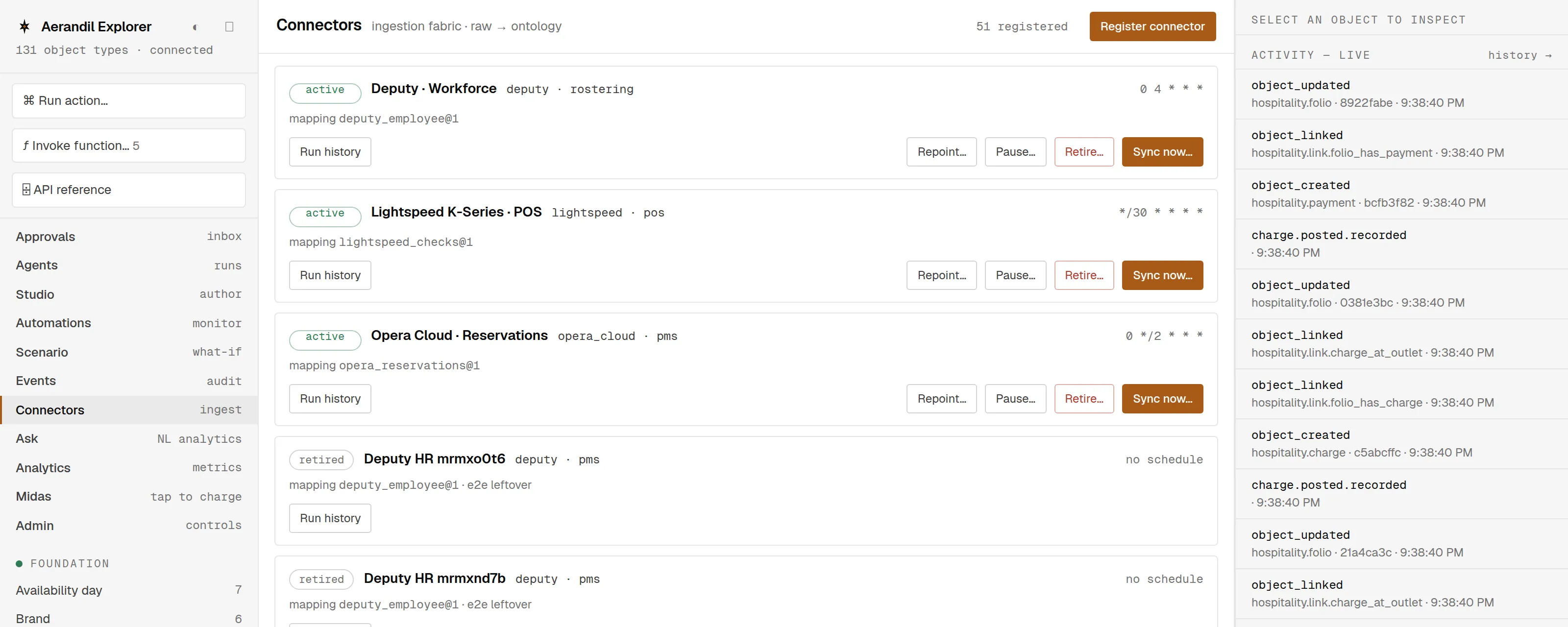
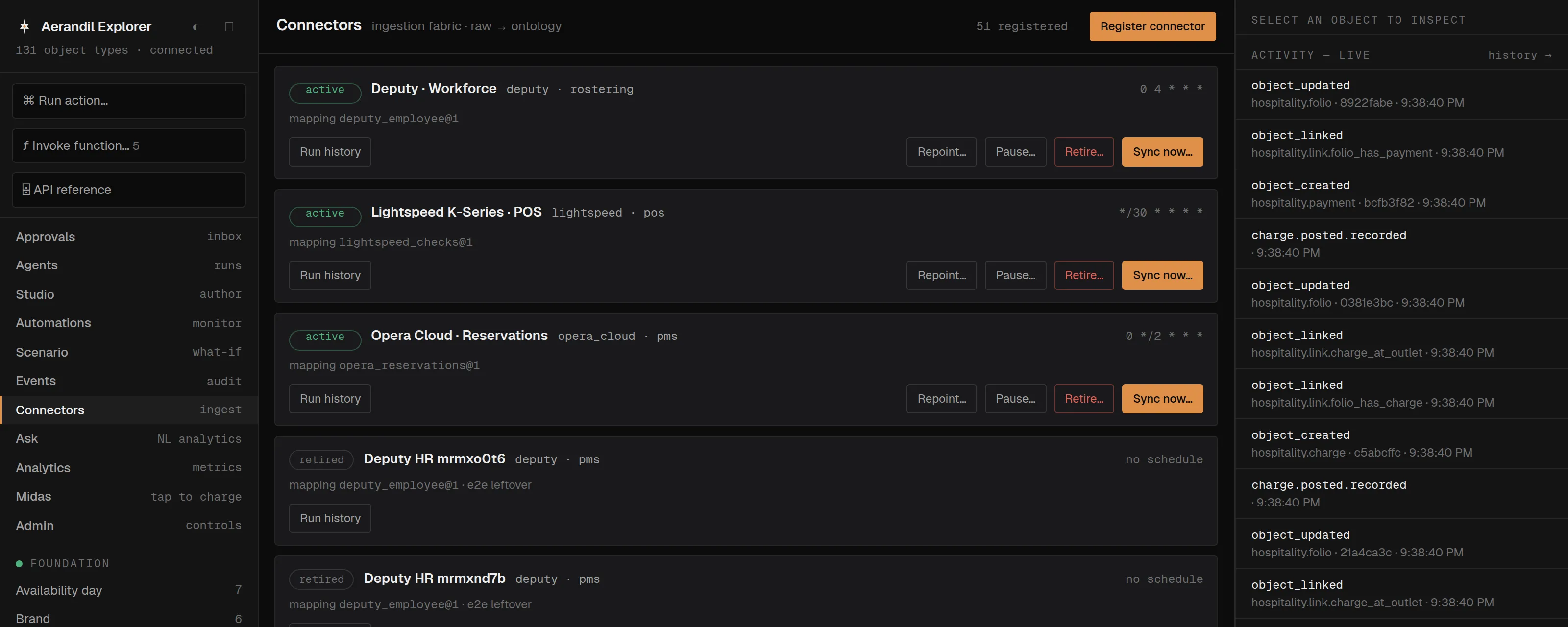
Every sync run opens and closes as an audited object in the same ontology it feeds — trigger, counts, and failures included.
The metrics hotels actually run on come from a governed catalogue, not a BI team's folklore. Each definition is USALI-aligned, carries its citation and version, and computes from live events — booking pace included — so every consumer reads the same number.
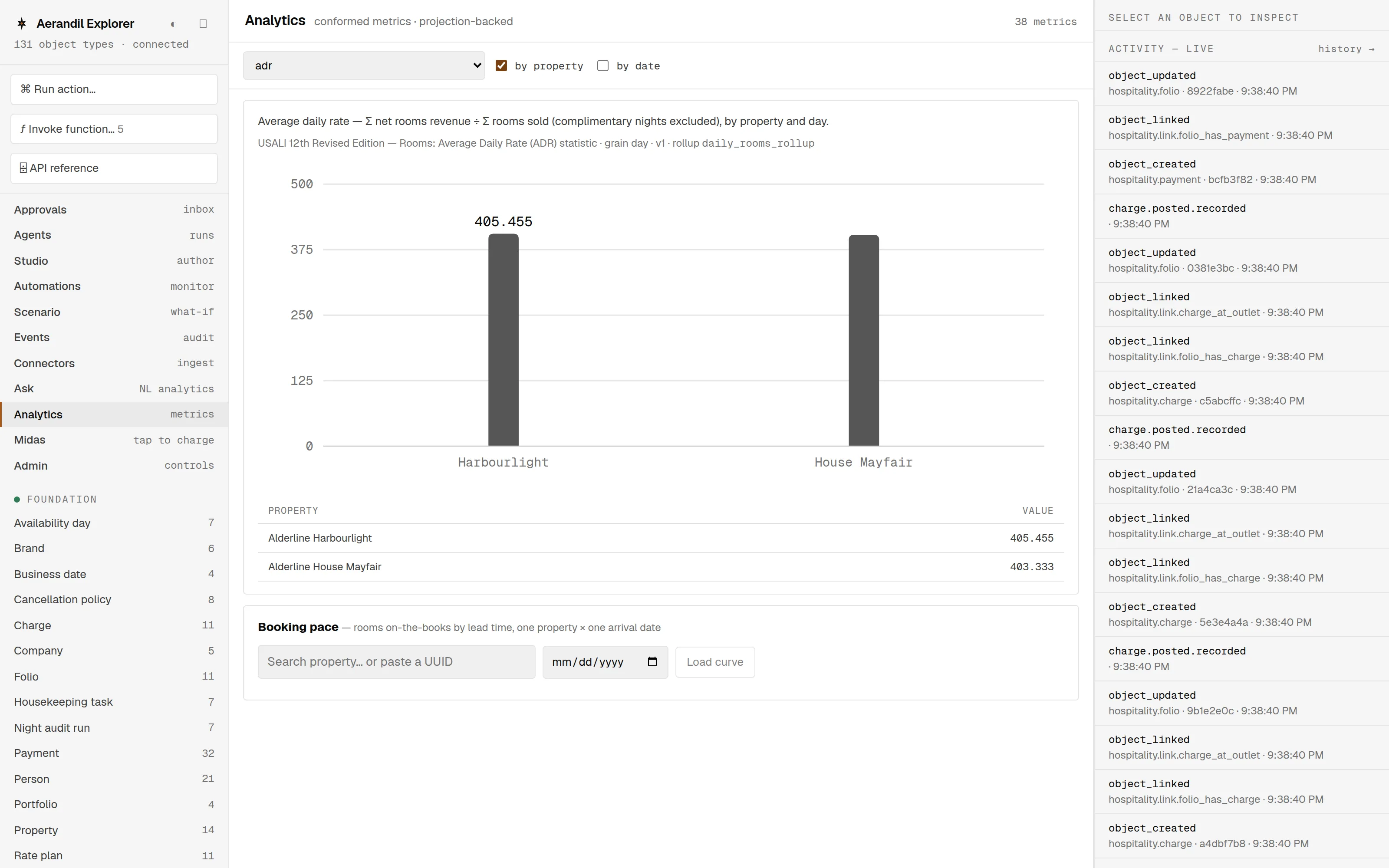
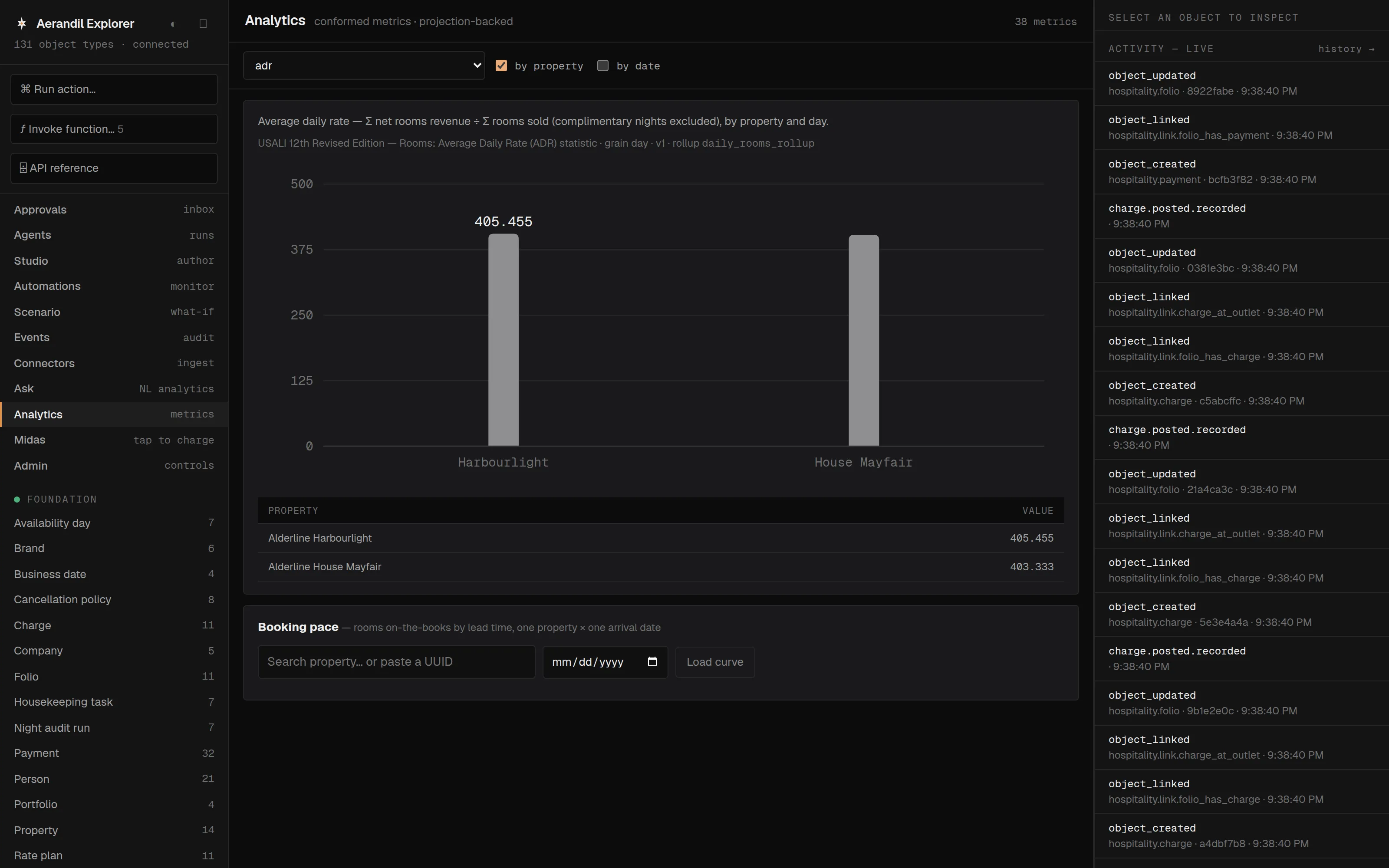
Σ net rooms revenue ÷ Σ rooms sold — USALI 12th Revised Edition, Rooms: ADR statistic.
Rooms revenue per available room, computed from the same posted-ledger facts as the folio.
Rooms on the books by lead time — one property × one arrival date, snapshotted continuously.
No proprietary store, no lock-in. Aerandil speaks the formats your team already trusts — and generates the rest from one source of truth.
Build on it
Aerandil is in private development. The next milestone is working with design partners who operate complex, multi-system hospitality businesses.
Design partner channel coming soon.