Property managementEarly access
Ithaca
For independent hotels and small groups.
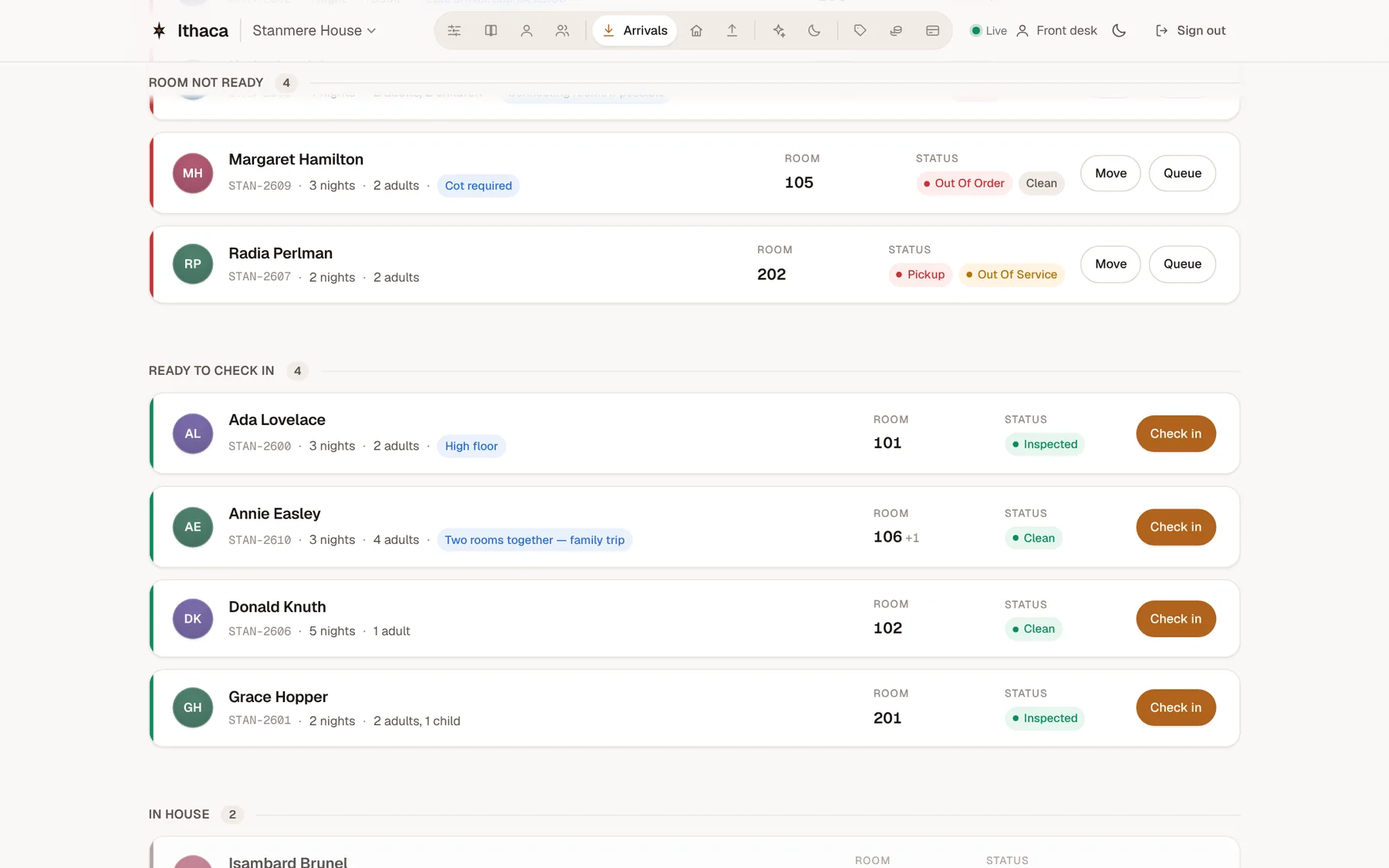
Check guests in, settle bills, turn rooms and close the day. Housekeeping and maintenance work from an app on their phone, and the desk sees every room the moment it's clean.
Behind this: a Saturday at Alderline Pendrake, a 44-room resort that does not exist, its bookings and dinner bills from our calibrated demand generator. Hover a room for its stay. The floor plan and housekeeping times are illustrative.
Alderline Pendrake · 44 rooms · syntheticSat 31 Oct · 06:00
What changes at the deskArrivals → the close
Built in the order the day runs.
The queue at three in the afternoon, the room still dirty at four, the bill that won't close at eleven, the audit that has to run before any of it counts. Ithaca was built in that order, one screen at a time, against a hotel with guests in it.
01Check-in in one dialogRoom, arrival time and card guarantee confirmed together, then the guest is in. No “Are you sure?” pop-ups in front of the guest.
02Rooms ready the moment they're cleanHousekeepers finish a room on their phone and the desk sees it ready straight away. A fault found in a room goes straight to maintenance.
03An audit that says what's in the wayGuests who never arrived and departures still in house are listed before you start, with a preview of exactly what closing the day will post.
04Mistakes reversed, never erasedEvery check-in, charge and payment records who did it. A wrong charge is reversed rather than deleted, so the history always adds up.
Built for independent hotels and small groups. Ithaca is demonstrable today; it is not yet generally available.
Watch itThe real desk, a sample hotel
A minute at the front desk.
Recorded on Ithaca itself, on a hotel with a full day ahead: arrivals waiting, guests in house, bills to settle. The guests are made up; every click is the real product.
Try it yourself
Click through a day at the desk.
Sixteen real screens: check a guest in, send a bill to a company, clean the room from the mobile app, and close the day. Click the highlighted control at each step, at your own pace.
Take the tourIthaca mobileiPhone & Android · coming soon
Housekeeping and maintenance, on a phone, not a paper sheet.
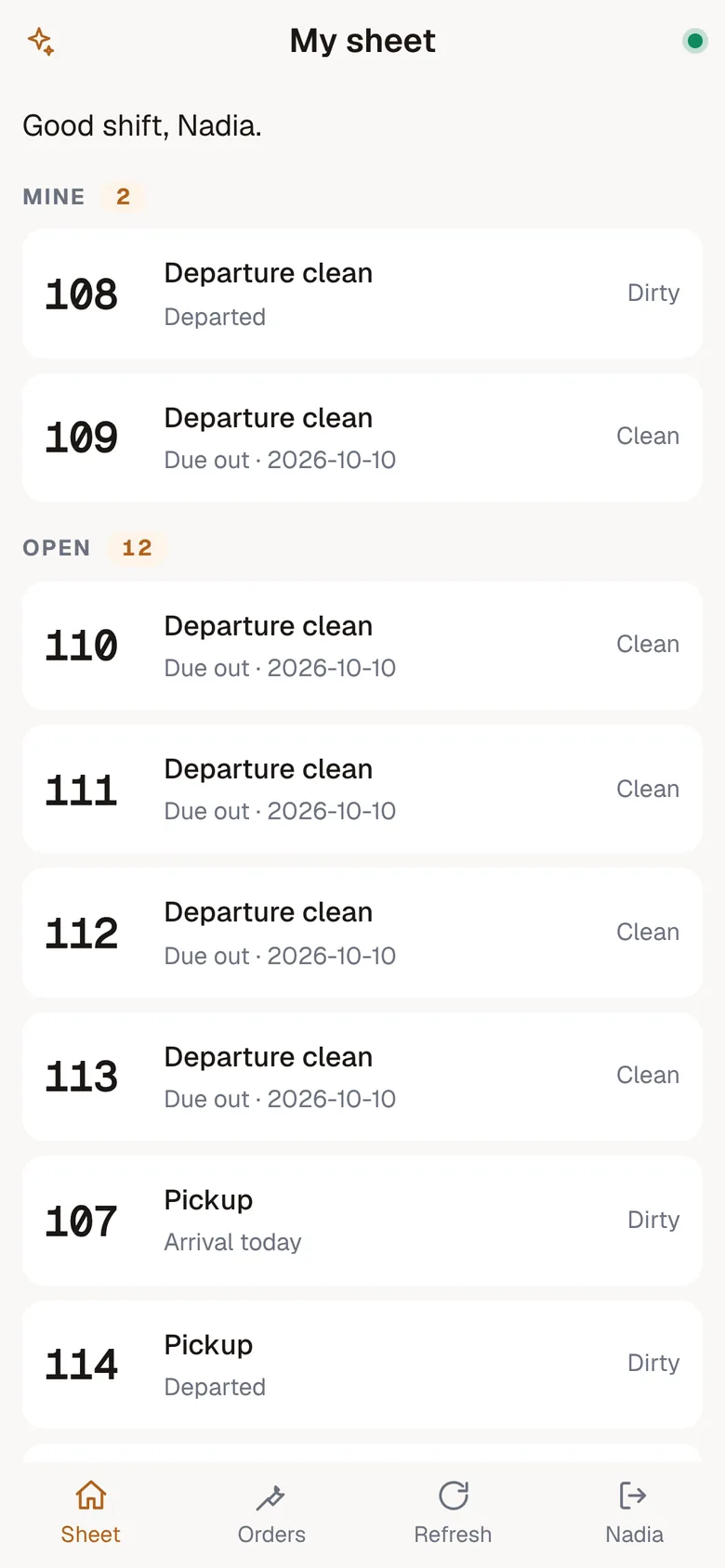
Housekeepers and engineers work from one app on their phone, connected to the same hotel as the desk — so a room finished upstairs is ready downstairs before anyone says so, and a fault reported in a room is with maintenance straight away. Staff sign in on a shared phone with an employee number and passcode, or on their own.
Their rooms, in orderHousekeepers see the rooms that need them, most urgent first. A supervisor sees the whole floor and can reassign, inspect or take a room out of order.
One tap to start, one to finishFinishing records the room's new state in the same tap. “Can't get in” and “Skip” take a reason, so the desk isn't left guessing.
Report a fault from the roomAnyone on the floor can report a fault where they find it — what it is and how urgent — and it becomes a work order for maintenance.
Work orders for engineersEngineers see the open work orders, start one, and close it with what they did. The desk sees it the moment it's done.
Preventive maintenanceScheduled checks raise their own work orders when they fall due, and book the next one when they're closed.
A nudge when it mattersA notification when a room is handed to them, a task turns urgent, or a work order lands for them. No signal on the third floor? Housekeeping taps wait on the phone and send once it's back.
The Ithaca mobile app is coming to the App Store and Google Play. Today it runs in the phone's browser and installs to the home screen.
One systemAdd what you need
Start with the PMS. Add what you need.
Ithaca is one system, not a bundle of products to connect. Every add-on works on the same rooms, guests and bills as the desk, so there is nothing to sync and nothing to reconcile.
The PMSIthacaArrivals, departures, in house, the rack, reservations, guests, rates, payments, invoices and the night audit.
Free with every planIthaca appHousekeeping and maintenance on the phone: rooms, faults, work orders and preventive maintenance.
Add-onEventsGroup blocks and pickup, rooming lists, the group's master bill, the function diary and banquet orders.
Add-on · laterRevenueRate recommendations for the nights ahead, each with its reasoning — pace against normal, pickup — and a person approves before any price changes.
Aerandil PaymentsPaymentsCard on file, deposits by link, no-show fees, refunds and disputes, and Charge to key — a guest taps their room key at the bar or spa and the charge lands on their bill. The money on the same bill as the stay, across every Aerandil product.
Pricing is shared in a walkthrough while Ithaca is with its first hotels.
The boardsTwelve, plus the sheets
The whole front office, not the demo half.
A system is usually judged on the awkward jobs: commissions, disputes, credit notes, the group's banquet order. Ithaca covers arrivals through the night audit, housekeeping and maintenance, groups and events, and the money in both directions.
ArrivalsWho's arriving, whether their room is ready, room assignment and check-in — a family in three rooms checked in room by room.
DeparturesSettle the bill: card, cash, deposit, send it to a company's account, or refund a credit — and issue the invoice as the guest leaves.
In houseEveryone staying tonight with their running balance. Post a charge, move a room, change the dates.
HousekeepingEvery room by floor with its cleaning status, out-of-order blocks, discrepancies, tasks and work orders.
TimelineRooms by night. Drag a booking to another room, and the system says straight away whether it fits.
ReservationsOne search box over every booking, and a new booking in a single dialog. Sold out offers the waitlist.
GuestsThe person, not just the stay: history, preferences, ID documents, cards on file, and merging duplicates.
Groups & eventsRoom blocks and pickup, rooming lists, the group's master bill, function diary and banquet orders.
RatesThe next fortnight: rooms left to sell, the price, and every restriction on each night.
CommissionsWhat the hotel owes the travel agents who sent it business, totted up each night and paid in batches.
PaymentsMoney still in motion: invoices due, payment links, disputes and their deadlines, no-show fees, refunds on their way.
Night auditWhat's still open before the close, the close's steps as switches, a preview of what it will post, then the close itself.
The night audit
The audit says what's in the way before you start.
Night audits fail the same four ways everywhere: guests who never checked in, departures still in house, charges not posted, a cash drawer left open. Ithaca lists them at the top before the auditor starts, so the desk can clear what it wants cleared — the close never stops on them — and shows a preview of exactly what closing will do, so the first time anyone sees the result isn't while it's happening.
The end-of-day report comes straight off the close: rooms and occupancy, the day's arrivals and departures, revenue by department, payments by method, rooms out of order, ADR, RevPAR and TRevPAR, and a trial balance across every ledger.
- 01 Sweep no-shows
- 02 Post room and tax
- 03 Enforce deposits
- 04 Release block cut-offs
- 05 Accrue commission
- 06 Expire the waitlist
- 07 Retire expired cards
- 08 Balance packages
- 09 Open tomorrow
The rulesFrom the complaint record
Checked against what desks complain about.
We read what front-desk staff say about the systems they already have — unfiltered, in their own words — and turned the recurring complaints into rules every screen is checked against.
No interrogative pop-upsSafe actions just happen and offer an undo. Unsafe ones are refused, with the reason. “Are you sure?” is a tax the desk pays in front of a guest, and it trains people to click through the one dialog that mattered.
The desk's own wordsThe screens say arrivals, folios, blocks, work orders — the words the desk already uses on the phone, not ones invented by the software.
Reports from the same numbersThere's no separate reporting product to fall out of step. Reports come from the same records as the desk, and if a figure isn't up to date yet, the page says so instead of showing an old one.
Your payment provider, your relationshipDisputes, refunds, card holds and no-show fees show up on the bill with the card network's own status — not in a black box somebody else reconciles.
No gated APINo certification fee for connecting your own systems, no metered sandbox, no marketplace cut. The interface Ithaca is built on is the one you get.
Corrections, not rewritesA mistake is corrected, never covered up: reverse the charge, reopen the bill, credit the invoice. The record of what happened is never rewritten.
For your IT teamNo private door
Our own PMS is just another caller.
Ithaca has no privileged access. Every screen writes through the typed, permissioned, validated actions the platform exposes to everyone — and when a screen needed something the platform lacked, the platform grew and every integrator got it too.
# The Arrivals board checking a guest in. No private door:
# this is the request any integrator, SDK, or agent would make.
POST /v1/actions/hospitality.action.check_in/apply
Idempotency-Key: 0f4c7e21-9b3d-4a17-8c55-2e9a61d0b7f3
{
  "target": { "object_type": "hospitality.reservation", "id": "0192f3c4-…" },
  "params": { "arrival_actual": "2026-10-31T15:42:00Z" }
}

→ 200 OK   { "correlation_id": "…", "modified_objects": [ … ] }

# …and on the append-only log, for every board tailing it:
   event   reservation.checked_in.decided
actor
The desk signs in as a person through WorkOS, resolved to their staff record. Every check-in, posting and payment carries a name; a leaver's record is refused.
Idempotency-Key
A retried click cannot double-charge, double-refund, or check a guest in twice — on the desk, on the mobile app's offline queue, and for any other caller alike.
event
Every write lands on an append-only log. The audit trail is not a feature of Ithaca; it is the only way anything gets written.
seq
Every board follows one event stream and refreshes quietly when another surface writes — a phone, an agent, another desk.
Ithaca does not run the restaurant or the bar. A charge-to-room rung on any till — ours or a third party's — posts to the guest's Ithaca bill through the same public interface any integrator could call. The products stay separate; the guest's bill does not.
Ithaca is Odysseus's island — the place at the end of the journey. A hotel is where a traveller arrives and rests, and the front desk is the door they arrive through.
Walkthrough
See a day at the desk,
end to end.
We set up a hotel shaped like yours, with today's arrivals, guests in house, departures, a housekeeping sheet and a group block, and work the day with you live. Check a guest in, settle a bill, run the night audit.
Book a walkthroughWalkthroughs run live, over a video call. Or take the self-guided tour first.